
Menu
Log in


Leonard Boyle Dissertation Prize for Medieval Studies

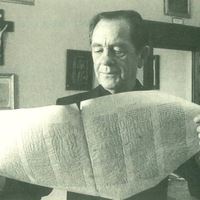
A black-and-white photograph of a man (Leonard Boyle) with black hair, reading two pages bound together, each with three columns of text. The Canadian Society of Medievalist/Société canadienne des médiévistes (CSM/SCM) awards the Leonard Boyle Dissertation Prize annually to an outstanding dissertation in any field of medieval studies that was successfully defended in 2023 by a Canadian or by an international student at a Canadian institution. 

Our annual dissertation prize honours the memory of Fr. Leonard E. Boyle (1923-1999). Fr. Boyle, an Irish Dominican friar, commenced work for a B. Litt. degree at Oxford, but the quality of his project allowed him to transfer to the D.Phil., which he completed in 1956. His particular research expertise was in Latin paleography and in the history of canon law, philosophy, theology, clerical education, and pastoral care. Fr. Boyle taught graduate students at the Pontifical Institute of Mediaeval Studies and the Centre for Medieval Studies at the University of Toronto from 1961 to 1984. His courses prepared scholars to read and investigate medieval manuscript books and documents. As Prefect of the Vatican Library from 1984 to 1997, he helped to modernize the library and to make it more accessible to researchers. He was made an Officer of the Order of Canada in 1987. He is buried in Rome’s Basilica of San Clemente.

Congratulations to Dr. Bard Ruth Swallow

Winner of the 2026 Leonard Boyle Dissertation Prize

Dr. Bard Ruth Swallow, "Formal Functions of Latin Poetry in Fourteenth-Century England" (PhD diss., Centre for Medieval Studies, University of Toronto, 2025).

Dr. Swallow’s dissertation merits the Leonard Boyle Dissertation Prize for Medieval Studies as an original, methodologically sophisticated, and intellectually ambitious contribution to the study of medieval literature, multilingualism, and prosody, distinguished throughout by writing of exceptional clarity, precision, and elegance. Its central intervention—demonstrating that language choice in fourteenth-century England was shaped not only by audience or authority but by access to specific formal and prosodic possibilities—reorients a major field of inquiry. Rather than treating Latin, Anglo-French, and Middle English as stable cultural categories, the dissertation shows that each language offered distinct formal affordances, and that medieval poets actively selected among them to achieve particular effects. It makes a major contribution to the study of medieval multilingualism by shifting attention from language choice alone to the relationship between language and form. This insight is pursued with acuity and rigour across a carefully structured argument that moves from strictly prosodic analysis to broader questions of genre, convention, and material context.

The dissertation’s originality is particularly evident in its treatment of commemorative verse, where it establishes a clear methodological and conceptual framework for analyzing funerary inscriptions and related texts. It demonstrates how memorial language is shaped by medium, setting, and imagined audience, opening broader questions about death, memory, and the staging of commemoration. This line of inquiry culminates in a compelling analysis of John Gower’s tomb, which brings together multilingualism, prosody, material culture, and reception history. The dissertation shows that the inscriptions are deliberately unconventional, using formal deviation and prosodic sophistication to foreground Gower’s identity as a poet. By treating uncertainty of authorship not as a limitation but as a critical insight, it reveals commemorative verse as a site where authorship, authority, and poetic self-fashioning intersect. The committee wishes to convey its admiration and congratulations to Dr. Swallow on this magnificent PhD dissertation.

This was an exceptionally strong field in which every submission was notable; nevertheless, we would like to single out for honourable mention Dr. Emma Gabe, "Sorores in coquina: Laysisters in German Monasteries, c. 1300–1550" (PhD diss., Centre for Medieval Studies, University of Toronto, 2025).

Dr. Gabe’s dissertation receives this distinction in recognition of its originality, breadth, and methodological sophistication. By taking a wide comparative view across multiple monastic orders in the German territories, it offers a richly nuanced account of the role, social status, and devotion of lay sisters, significantly deepening our understanding of this form of religious life. Particularly notable is the clarity and ease with which detailed material is presented, making the study both accessible and analytically compelling.

Dr. Brandon Alakas (University of Alberta)

Dr. Adam Bishop (Independent Scholar)

Dr. Carolyn Muessig (University of Calgary, Chair)

2026 Leonard Boyle Dissertation Committee


Past Winners of the Leonard Boyle Dissertation Prize

2025 - Laura Moncion, "'Closen leben das ist nut ein cleines ding': Women Recluses in Alsace c. 1200-1500" (University of Toronto, 2024).

2024 - Alessia Berardi,  Vita, scientia, doctrina: Stephen Langton and the biblical model of the “good master” (University of Toronto, 2023).

2023 - Arnaud Montreuil, « Écrire, décrire, saisir l’adoubement chevaleresque : une histoire de l’hippotogenèse dans l’Europe du Nord-Ouest, le Midi de la France et l’Italie centro-septentrionale (v.1175- v.1300) » (Université d'Ottawa, 2022).

2022 - Stephanie Lahey, "Offcut Zone Parchment in Manuscript Codices from Later Medieval England" (University of Victoria, 2021). Honourable mentionHannah Kirby Wood, "Intersections of Voluntary and Involuntary Poverty: The Friars and the Lay Indigent in Late Medieval England, 1221-c. 1430" (University of Toronto, 2021).

2021- Amélie Marineau-Pelletier, "Écrire, traduire et conserver les lettres missives à Metz: enjeux documentaires et domination sociale des paraiges (XIVe-XVIe siècles)" (Université d'Ottawa, 2020)

2020 - Atri Hatef Naiemi, "A Dialogue between Friends and Foes: Transcultural Interactions in Ilkhanid Capital Cities (1256-1335 AD)" (University of Victoria, 2019).

2019 - Ronald Lvovski. “Building Context: the Church of San Julián de los Prados and Medieval Architecture in the Kingdom of Asturias (718-910).” (Toronto: Art History and Visual Culture, York University, 2018)

2018 - Kenneth F. Duggan, "“Communal Justice in Thirteenth-Century England”  (Kings College London, 2017)

2017 - Amanda McVitty, “Treason, Manhood, and the English State: Shaping Constitutional Ideas and Political Subjects through the Laws of Treason, 1397-1424” (Massey University, New Zealand, 2016)

2016 - Rowan Dorin, “Banishing Usury: The Expulsion of Foreign Moneylenders in Medieval Europe, 1200-1450” (Harvard, 2015)

2015 - Magda Hayton, "Inflections of Prophetic Vision: The Reshaping of Hildegard of Bingen's Apocalypticism as Represented by Abridgments of the Pentachronon" (University of Toronto, 2014)

2014 - Lucie Laumonier, "Vivre seul à Montpellier à la fin du Moyen Âge" (Université de Sherbrooke and Université Montpellier, 2013)

2013 - Ariella Elema, "Trial by Battle in France and England" (University of Toronto, 2012)

2012 - Giselle Gos, "Constructing the Female Subject in Anglo-Norman, Middle English, and Medieval Irish Romance" (University of Toronto, 2011)

2011 - Martin Gravel, "Distances, recontres, communications: Les defis de la concorde dans l'Empire carolingien" (Université de Montréal and the Université de Paris 1, Panthéon-Sorbonne 2010)

2010 - Richard Matthew Pollard, "Literary Culture in Ninth-Century Northern Italy" (University of Cambridge, 2009)

2009 - Laura Marchiori, “Art and Reform in Eleventh-Century Rome: The Paintings of S. Maria in Pallara” (Queen’s University at Kingston, 2008)

2008 - No Prize Awarded

2007 - Marica C. Cassis, “Mensa, Thusiasterion, and Madebha: The Evolution of the Permanent Altar in the Early Christian Church” (University of Toronto, 2006)

2006 - Caroline Boucher, “La mise en scène de la vulgarisation. Les traductions d’autorités en langue vulgaire aux XIIIe et XIVe siècles” (Université de Paris, CNRS, 2005)

2005 - Robin Vose, “Converting the Faithful: Dominican Mission in the Medieval Crown of Aragon” (Notre Dame University, 2004)

2004 - Harriet Sonne de Torrens, "De Fontibus Salvatoris: A Liturgical and Ecclesiological Reading of the Representation of the Childhood of Christ on the Medieval Fonts from Scandinavia" (Copenhagen University, 2003)

2003 - Oren Falk, “The Cultural Construction of Violence in Medieval Western Scandinavia” (University of Toronto, 2002)

2002 - Maidi Hilmo, “Images, Icons, and Texts: Illustrated English Literature from the Ruthwell Cross to Ellesmere Chaucer” (University of Victoria, 2001)

© 2019-20 The Society of Canadian Medievalists. Designed and Developed by Andrew Klein and Elias Fahssi. All rights reserved.  Powered by Wild Apricot.

Powered by Wild Apricot Membership Software